Soit le fichier products.json
{ "products" : [
{ "Name": "Cheese", "Price" : 2.50, "Location": "Refrigerated foods"},
{ "Name": "Crisps", "Price" : 3, "Location": "the Snack isle"},
{ "Name": "Pizza", "Price" : 4, "Location": "Refrigerated foods"},
{ "Name": "Chocolate", "Price" : 1.50, "Location": "the Snack isle"},
{ "Name": "Self-raising flour", "Price" : 1.50, "Location": "Home baking"},
{ "Name": "Ground almonds", "Price" : 3, "Location": "Home baking"}
]}
On peut comparer les écritures :
fetch('products.json')
.then(function(response) {
//console.log(response)
return response.json();
})
.then(function(json) {
let myList = document.querySelector('ul');
myList.innerHTML = `${json.products.map(p => `<li> ${p.Name} </li>`).join('')}`;
});
---------
let myList = document.querySelector('ul');
fetch('products.json')
.then(function(response) {
//console.log(response)
return response.json();
})
.then(function(json) {
let li='';
for (let p of json.products){
li+= `<li><strong> ${p.Name} </strong></li>`
}
myList.innerHTML = li;
});
-------------
let myList = document.querySelector('ul');
fetch('products.json')
.then(function(response) {
//console.log(response)
return response.json();
})
.then(function(json) {
for (let p of json.products){
let li = document.createElement('li');
li.innerHTML = `<strong> ${p.Name} </strong>`
myList.appendChild(li);
}
});
correction
EX1
let max = arr.reduce(function(a,c) { return (a.length> c.length)?a:c;});EX2

EX3
let calcul = function (rayon) {
const PI = 3.14;
let perimetre = 2*PI*rayon,
volume = 4/3*PI*Math.pow(rayon,3),
diametre = rayon+rayon;
return {perimetre,volume,diametre};
};
let {perimetre,volume} = calcul(val);EX4
function foo ( ...args ) {
args = args.filter( v => v % 2 == 0);
console.log( args );
}
EX5
console.log(amis.reduce(function(prev, curr) {
return [...prev, ...curr.prenoms];
},[]););
window.getComputedStyle
window.getComputedStyle donne les propriétés d'un éléments.
Remarque
Le plus grande clé peut être obtenue avec :
Math.max(...Object.keys(cssObj).map(v=>v.length))
Remarque
Le plus grande clé peut être obtenue avec :
Math.max(...Object.keys(cssObj).map(v=>v.length))
Décomposition : fonction fléchée
Définition
let f = ([a, b] = [10, 10], {x: c} = {x: a - b}) => a + b + c;Paramètres
f([2,3],{x:10});
f = ([a, b], {x: c}) => a + b + c;
// 15 = 2 + 3 + 10
Paramètres
f([2,3]);([a, b], {x: c} = {x: a - b}) => a + b + c;
// 4 = 2 + 3 + ( 2 - 3 )
Paramètres
f();f = ([a, b] = [10, 10], {x: c} = {x: a - b}) => a + b + c;
// 20 = 10 + 10 + ( 10 - 10 )
for of
let tabPers = [ {
nom: "Dupont",
sex : "f",
},
{
nom: "Brusel",
sex : "h",
},
{
nom: "Dupont",
sex : "f",
},
];
for(let v of tabPers) { console.log(`${typeof v}, ${v instanceof Object}`)}


for(let v of tabPers) { console.log(`${typeof v}, ${v instanceof Object}`)}
Etude de v

Déboggeur

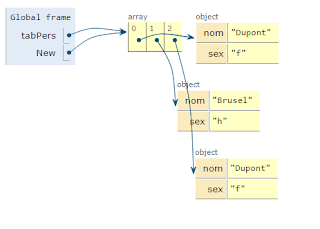
Rappels sur les objets, tableaux et pointeur !
let tabPers = [ {
nom: "Dupont",
sex : "f",
},
{
nom: "Brusel",
sex : "h",
},
{
nom: "Dupont",
sex : "f",
},
];
ou
let tabPers = [ {
nom: "Dupont",
sex : "f",
},
{
nom: "Brusel",
sex : "h",
},
{
nom: "Dupont",
sex : "f",
},
];



ou
let tabPers = [ {
nom: "Dupont",
sex : "f",
},
{
nom: "Brusel",
sex : "h",
},
{
nom: "Dupont",
sex : "f",
},
];

Dessiner le résultat du code
let a = tabPers[1];

Dessiner le résultat du code
let a = tabPers[1];
let b = a["nom"];

Dessiner le résultat du code
let New = tabPers;

Dessiner le résultat du code
let New = tabPers;
New[2] = tabPers[0] = New[1];

code transf
let tabPers = [ {
nom: "Dupont",
sex : "f",
},
{
nom: "Brusel",
sex : "h",
},
{
nom: "Dupont",
sex : "f",
},
];

function toUpperName(person) {
person.nom = person.nom.toUpperCase();
return person;
}
function transf(array, fx) {
let passed = [];
for(let v of array)
passed.push(fx(v));
return passed;
}
let T = transf(tabPers,toUpperName);
nom: "Dupont",
sex : "f",
},
{
nom: "Brusel",
sex : "h",
},
{
nom: "Dupont",
sex : "f",
},
];

function toUpperName(person) {
person.nom = person.nom.toUpperCase();
return person;
}
function transf(array, fx) {
let passed = [];
for(let v of array)
passed.push(fx(v));
return passed;
}
let T = transf(tabPers,toUpperName);
Afficher T et tabPers
Inscription à :
Articles (Atom)